
Stargazing at Hunter's Moon
A house named after a moon, with a thousand stars on its ceiling, in a valley with no street lights: Hunter's Moon was made for stargazers. On a clear night the Milky Way arches over the garden, and the hot tub is the best observatory in Somerset.
Dark skies over the Levels
Hunter's Moon sits on the southern slope of Pennard Hill, screened by woodland from the few lights of West Bradley and looking out over open fields. There is no street lighting in the lane, and the nearest town, Glastonbury, is five miles away behind the hill. On a clear, moonless night the sky is properly dark: the Milky Way is obvious from late summer to autumn, the Andromeda galaxy can be picked out with the naked eye, and the Perseid meteor shower in mid-August and the Geminids in mid-December put on a show. Turn off the garden lights, give your eyes twenty minutes and lie back on the loungers or in the hot tub.
The hunter's moon
The house takes its name from the full moon that follows the harvest moon, usually in October, when the moon rises soon after sunset for several nights running and hunters could work late into the evening by its light. Seen low over the Somerset Levels it appears huge and orange, and from the master-suite balcony or the decking above the stream it is a sight worth planning a stay around. Full-moon dates are printed on the calendar in the kitchen.
Learn the constellations in the pod
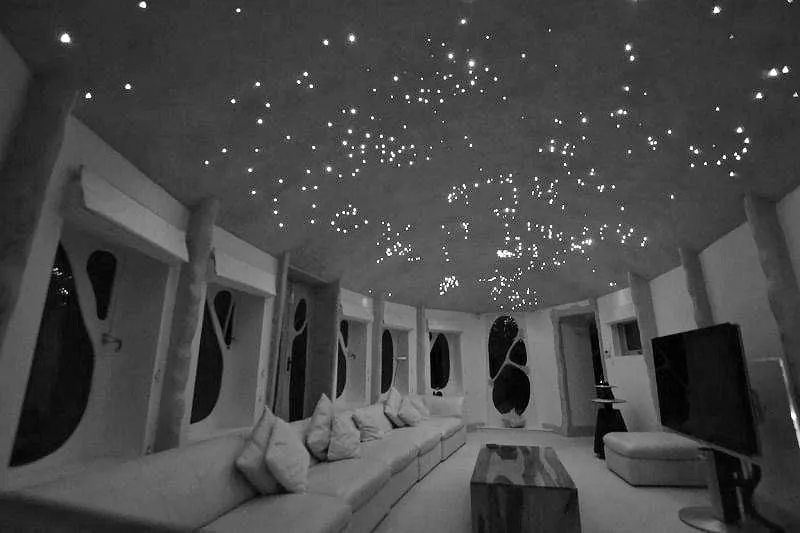
The cinema pod has more than a thousand fibre-optic stars set into its domed ceiling, arranged into real galaxies and constellations. It makes a perfect planetarium for learning the shapes before you go outside: find the Plough, follow its pointers to the Pole Star, then Cassiopeia's W, Orion and his belt in winter, and the Summer Triangle of Vega, Deneb and Altair. A star chart and a pair of binoculars are in the house; a phone app that identifies stars when you point it at the sky is even easier.
Exmoor International Dark Sky Reserve
For the darkest skies in southern England, Exmoor National Park was Europe's first International Dark Sky Reserve. The moorland car parks at Holdstone Down, Webbers Post and Wimbleball Lake are recommended viewing spots, and the park runs a Dark Skies Festival each October with guided stargazing and telescope sessions. It is about an hour and a quarter from the cottage; see coast and Exmoor. Closer to home, the Mendip plateau around Priddy and the Polden ridge are good dark viewpoints.
Stargazing tips
- Check the moon phase: the week either side of a new moon is best for stars, the full moon for the moon itself
- Give your eyes twenty minutes to adapt and use a red torch, not a phone screen
- Binoculars show more than a cheap telescope: try them on the Moon, the Pleiades and Jupiter's moons
- Winter nights are longest and clearest; bring warm layers or use the hot tub
- Look for the International Space Station, which passes over Somerset most weeks (times online)
- The ley lines and the Glastonbury Zodiac give the sky here a mythology of its own; see history of the area
Sleep under the stars, indoors
Check availability at Hunter's Moon.
Check availability