
The history and legends of Glastonbury and Avalon
Few places in Britain carry as much history and myth as the few square miles around Hunter's Moon. This was the Isle of Avalon, where Arthur was carried after his last battle; the place where Joseph of Arimathea planted his staff; the site of England's richest abbey; and, if you believe the ley-line hunters, the heart of a vast zodiac laid out in the Somerset landscape.
An island in a marsh
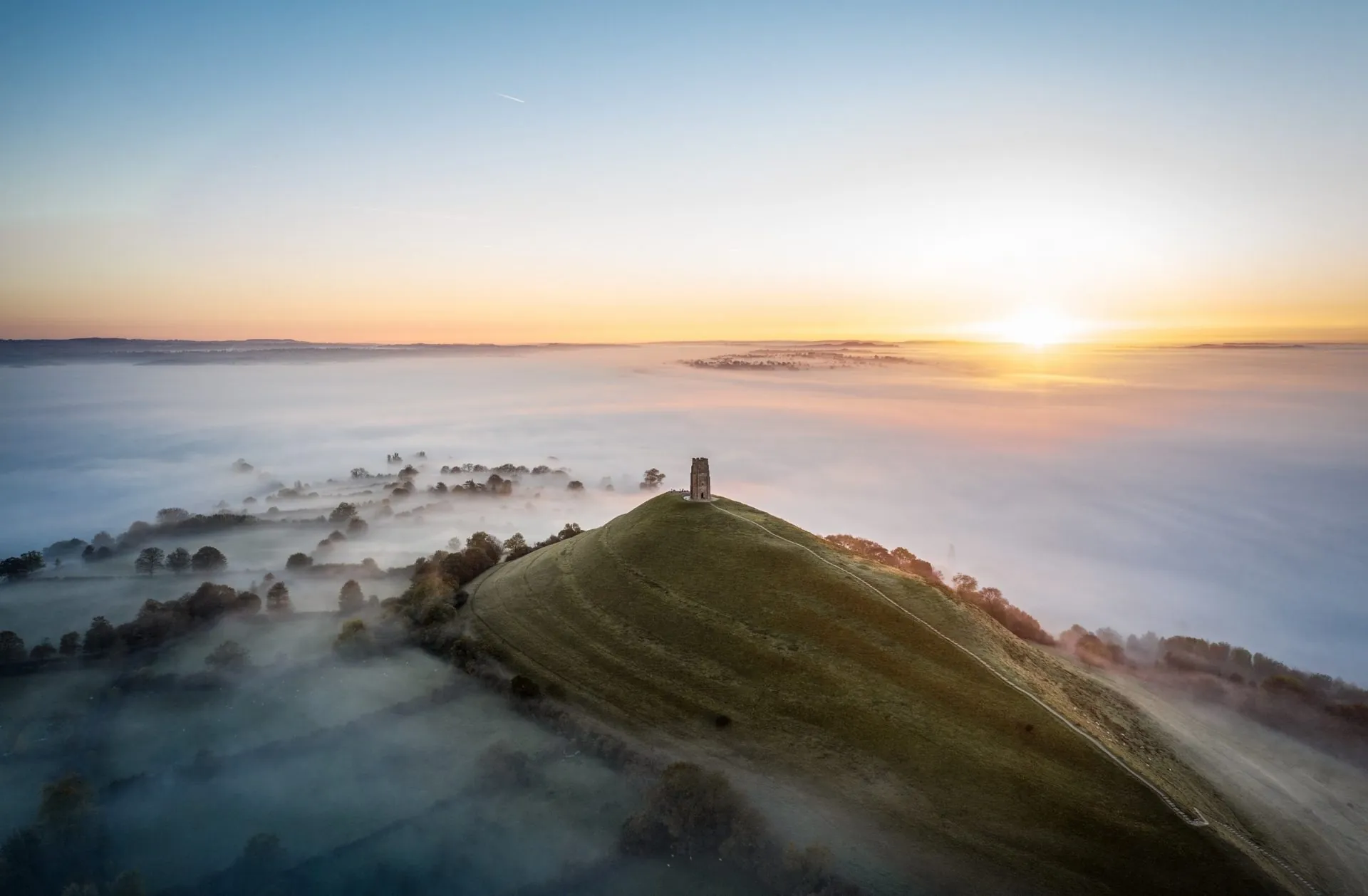
Until the Somerset Levels were drained in the Middle Ages, Glastonbury really was an island. The sea reached inland as far as the foot of the Tor, and the surrounding land was a tidal marsh of reeds and open water. The Tor and the low hills around it, including Pennard Hill where Hunter's Moon stands, rose from the water as true islands. The Celtic name Ynys Witrin, the Isle of Glass, and the later name Avalon, the Isle of Apples, both describe this drowned landscape. On a misty autumn morning, when the Levels vanish under a white sea and only the Tor breaks the surface, you can see exactly what those early settlers saw.
People have lived here for a very long time. The Sweet Track, a timber walkway across the marsh built in 3807 BC, is one of the oldest engineered roads in the world and was found a few miles west of the town. Iron Age lake villages stood on artificial islands at Glastonbury and Meare, their remains preserved in the peat, and the Romans farmed the drier ground.
Joseph of Arimathea and the Holy Thorn
Legend says that Joseph of Arimathea, the man who buried Christ, came to Britain after the crucifixion carrying the Holy Grail. Landing at Glastonbury, he climbed Wearyall Hill and drove his staff into the ground, where it took root and flowered as the Glastonbury Thorn, a hawthorn that blooms at Christmas as well as in spring. Descendants of that tree still grow in the Abbey grounds and at St John's Church, and a sprig is sent to the monarch every Christmas. Joseph is said to have buried the Grail beneath the Tor, where the red, iron-rich water of the Chalice Well has flowed ever since.
King Arthur and the Isle of Avalon
In 1191 the monks of Glastonbury Abbey announced that they had found the grave of King Arthur and Queen Guinevere in the abbey cemetery, marked by a lead cross. The bones were reburied before the high altar in 1278 in the presence of Edward I, and the site is marked in the ruins today. Whether or not the discovery was a medieval fund-raising stunt, it fixed Glastonbury as Avalon in the popular imagination: the island to which the wounded Arthur was carried by barge, where Excalibur was returned to the water, and where he sleeps until Britain needs him again.
The legends reach right up to Hunter's Moon. Pennard Hill, on which the cottage sits, is understood in local tradition to be the place where Arthur's army kept its horses, naturally protected by the water that surrounded the island in those days. The stream below the garden is still known locally as Witches Dip, a name from the centuries when the hill was associated with sorcery and witchcraft.
The Abbey
Glastonbury Abbey claimed to be the oldest church in Britain, founded by Joseph himself in the first century. Its documented history begins in the seventh century, when a Saxon king endowed a monastery on the site of an older Celtic one. Under St Dunstan, abbot in the tenth century and later Archbishop of Canterbury, it became the most important monastery in England, and by the fourteenth century it was one of the richest, second only to Westminster. Three Saxon kings were buried here.
It all ended in 1539. Henry VIII's commissioners dissolved the abbey, and its last abbot, Richard Whiting, was dragged up the Tor on a hurdle and hanged, drawn and quartered beside St Michael's Tower. The buildings were stripped for their lead and stone, and the ruins that remain, still magnificent, stand in 37 acres of parkland in the centre of the town.
The Tor and St Michael's Tower
Glastonbury Tor is a natural hill of clay and limestone, 518 feet high, its slopes terraced into what some believe is a huge three-dimensional labyrinth cut in the Neolithic period. A church dedicated to St Michael stood on top from at least the eleventh century; it was destroyed by an earthquake in 1275, rebuilt in the fourteenth century and dissolved with the abbey. Only the roofless tower survives. The Tor has been identified with the Celtic otherworld, the entrance to the land of the fairy king Gwyn ap Nudd, and with the Grail castle, and it has drawn pilgrims of every kind for thousands of years. It is managed by the National Trust and is free to climb at any hour; sunrise is the classic time.
Ley lines and the Glastonbury Zodiac
Two of Britain's most famous ley lines, the St Michael and St Mary lines, are said to cross at the Tor on their way from Cornwall to the Norfolk coast, passing through Avebury and a chain of St Michael churches. In 1935 the artist Katherine Maltwood proposed that the fields, lanes and rivers around Glastonbury form a vast circle of zodiac figures, ten miles across, laid out in prehistory: the Glastonbury Zodiac, or Temple of the Stars. Hunter's Moon lies on a powerful ley line within the figure of Sagittarius, the archer, whose horse and rider stretch across Pennard Hill. Whatever you make of it, the house has a stillness that guests remark on again and again.
The story of Hunter's Moon
Hunter's Moon began as a tiny cottage with an open fireplace dating back to 1580, in the reign of Elizabeth I, some forty years after the abbey fell. That hearth is still the heart of the snug. Over the following centuries the cottage was extended east and west, and in recent years it was transformed into the extraordinary house you see today, with a living tree rising through its centre, hand-carved oak doors and windows, stained glass and the starlit cinema pod curving out into the garden. The name comes from the full moon of October, the hunter's moon, which rises huge and orange over the Levels in the autumn.
Glastonbury today
The abbey's dissolution left Glastonbury a quiet market town for four centuries, known mainly for sheepskin and tanning. Its revival as a spiritual centre began with the Chalice Well Trust in 1959, the first festival in 1970 and the counter-culture of the following decades, which brought the shops, cafes and communities that make the town what it is. The Glastonbury Festival is actually held at Pilton, six miles east; see our festival page. To explore all of this for yourself, start with our places to visit.
Sleep on a ley line
Check availability at Hunter's Moon and explore Avalon from your own secluded corner of it.
Check availability